Why we still backtest in the age of AI
An AI can write ten trading strategies in a minute. That is exactly why the backtest matters more now, not less. Writing was never the hard part of trading; knowing whether what you wrote works is. AI made the first part free and left the second part untouched. A strategy without evidence is still a guess, however well it is written.
The problem didn't go away, it moved
Five years ago, the bottleneck was turning an idea into code. You had to learn MQL5 or Python, build a backtester or rent one, and debug it. Most ideas died there, which was wasteful but had one side effect: by the time something ran, you had thought about it for weeks.
Now the idea becomes rules in seconds, and the rules sound right. That is the risk. A model that has read every trading book writes strategies that read like every trading book. It can't tell you whether the one it just wrote would have survived March 2025, because it has never seen a price. Ask it, and it will give you a number anyway.
So the bottleneck moved from "can I build it" to "can I believe it". The backtest is the answer to the second question. It always was.
What a backtest is for
Not to predict the future. Markets change, costs bite, and the next year never looks like the last one. A backtest does three narrower things, and does them well:
1.It kills bad ideas fast. Most strategies lose on their first run. Better to find out in forty seconds on historical data than in three months on a demo account.
2.It shows you why. A real report doesn't give you a return; it gives you every trade, the rule that opened it and the reason it closed. You learn that the stop was too tight, or that one news day made the whole month, or that the entry rule fires at 3 a.m. when the spread is widest.
3.It makes iteration honest. Change one thing, run again, compare. Without a test, "improving" a strategy means making it sound better.
Why AI and backtesting belong together
The two are not rivals. The AI is fast and articulate and has no evidence; the backtest is slow to build and has nothing but evidence. Put them in a loop and each covers the other's weakness:
- The AI proposes a strategy and pins down the rules.
- The backtest runs those exact rules on real data with the costs you choose.
- The report comes back, and the AI reads it: where the losses came from, which rule caused them, what to try next.
- You change one thing and go around again.
That loop used to take a developer a day per iteration. In ChatGPT with Trader.AI it takes a minute, which means you can go around it twenty times in an evening. Speed was never the AI's problem; direction was. The backtest gives it direction.
A real example
On 11 November we asked ChatGPT, with Trader.AI installed, for a trend-following strategy on gold, 1-hour chart. It built a 12/48 EMA crossover, long and short, with a 2× ATR stop, and backtested it from January 2025 to November 2026.
The result: +0.13% with a 12.3% max drawdown over 244 trades, profit factor 0.99. ChatGPT's own verdict was "not ready for live trading". Version 1 report.
In the chat, that strategy read like every trend strategy ever written. Only the test showed where it failed: the short side lost $919 while the long side made $891, and stop-loss exits cost $1,522 in total. Those are two specific, testable observations, so we asked for one change: long-only, and only enter when ADX(14) is above 25.
Version 2, same dates and same zero costs: +1.87%, 2.96% max drawdown, 29 trades, profit factor 1.43. Version 2 report.
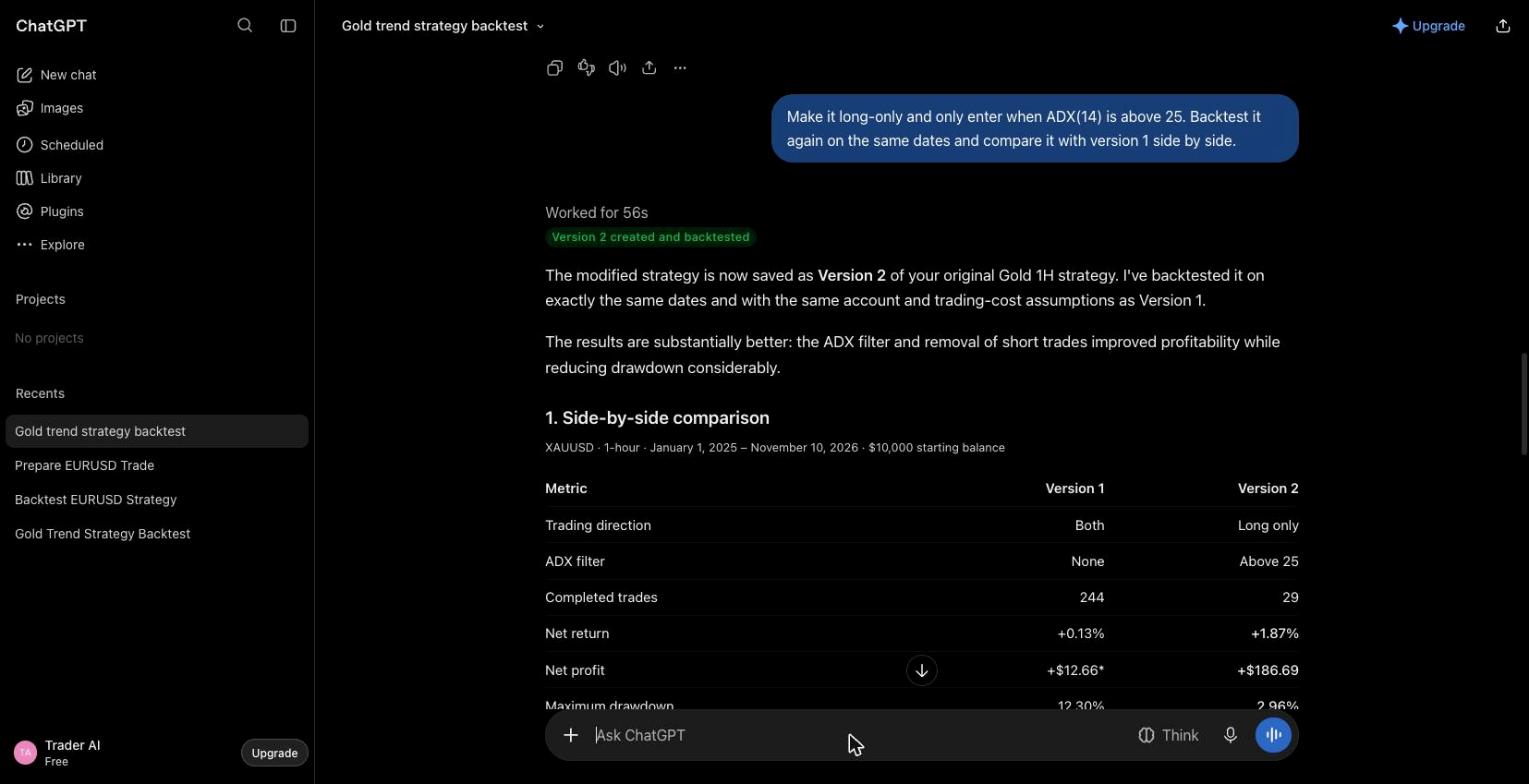
Note what the numbers are and aren't. Both runs are hypothetical, with zero spread and commission, on one symbol, over 22 months. Version 2's 29 trades are too few to trust, and the next step is testing ADX thresholds of 20 and 30 and adding real costs. None of this is a prediction. It is a reason to keep working on this strategy instead of the first one, which is the only thing a backtest can honestly give you. The whole loop, recorded without edits: watch the walkthrough.
What we won't do
Trader.AI won't place a trade, won't connect to your broker and won't tell you what to buy. It tests what you and your AI come up with, on real data, and shows every trade. If a strategy looks good, the next step is a demo account in your own MT5 terminal, not our opinion.
The short version
AI made strategies cheap. Evidence is still expensive, and a backtest is the cheapest evidence there is. The traders who do well in this era will not be the ones with the best prompts. They will be the ones who test the most ideas and discard the most.
Frequently Asked Questions
If AI can write strategies, why test them?
Because the AI has no price data and can't know whether its rules work. A backtest is the fastest way to find out which of its ideas would have survived real prices.
Isn't a backtest just curve-fitting?
It can be, if you only keep the best run. Test on different dates and different markets, change one thing at a time and keep every version; Trader.AI stores all of them so you can compare instead of remember.
Does a good backtest mean the strategy will make money?
No. It means the strategy was worth testing further. Costs, slippage and changing markets sit between any backtest and a live account; run survivors on a demo account first.
Can I do this in Claude or Gemini instead of ChatGPT?
Yes. Trader.AI connects to Claude, Gemini, Grok, Cursor and other MCP clients. The loop is the same.
Related Resources